
Back in beta! Stay tuned.

acoustics

Controlling Sound; NRC and Absorption
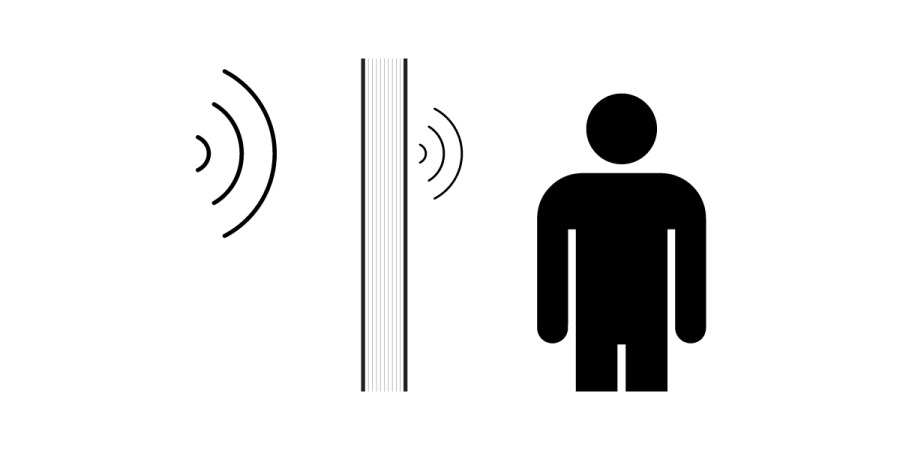
A simple illustration shows sound waves of varying frequency on one side of a vertical barrier and a person icon on the other, indicating how sound passes through or around the barrier to reach the person.

Controlling sound is crucial in architectural design, addressing external noise and internal room-to-room transmission to enhance user comfort. This guide explores three key strategies: reducing sound at the source, modifying space absorption, and introducing non-intrusive background noise. Understanding frequency-specific mitigation, exterior material considerations, and effective room planning criteria are essential for achieving optimal acoustic performance in any structure.
(STC) Sound Transmission & (IIC) Impact Isolation

A diagram shows sound waves traveling toward a vertical barrier, with reduced size as they pass through—illustrating Sound Transmission Class (STC)—and finally reaching an ear on the right side of the image.

Sound Transmission Class (STC) and Impact Isolation Class (IIC) are crucial metrics in architectural design, quantifying a barrier's ability to reduce airborne and impact noise, respectively. Understanding these values is essential for creating acoustically sensitive environments, from music venues to multi-family residences. This guide explores the nuances of STC and IIC, offering best practices for controlling sound transmission and impact isolation to enhance user experience and meet code requirements.

Sound Intensity & Loudness

A black outline of an ear is on the left, and a black outline of a speaker emitting sound waves, representing sound intensity and loudness, is on the right, both set against a white background.

Sound intensity, measured in decibels, and subjective loudness are crucial in architectural design. While 0 dB signifies no sound and 130-140 dB marks the pain threshold, factors like distance, listener age, and sound sources make sound perception highly variable. Understanding this logarithmic nature is key; simply adding sound values doesn't work. This nuanced approach ensures effective acoustic planning, balancing perceived change with implementation costs for optimal built environments.