


The AI Revolution…?
Approximately three years after the launch of ChatGPT, the AI industry appears to be reaching a critical turning point. Amidst frequent headlines suggesting an AI bubble, opinions are clearly polarizing as various groups take opposing stances on the industry’s future, and current usefulness. A brief, opinionated exploration examining the current intersection of Artificial Intelligence with the design and Architecture communities.
Pick Your Poison
On one hand, skeptics argue that AI offers minimal real-world value, especially when weighed against its substantial resource consumption, such as the vast electricity and land required for data centers—an issue recently brought before Congress. This side of the debate views the rapid proliferation of user-generated content as largely detrimental; the word “slop” was recently crowned 2025 word of the year by Merriam-Webster’s Dictionary, highlight the sheer volume of low-quality output being created generally termed as, “AI Slop”. While users can generate content faster than ever, this speed doesn’t seem to correlate with better art, useful insight, improved ideas, or anything beyond temporary, forgettable imagery. Memes, such as the instantly viral images of JD Vance are often cited as one of the best—and perhaps only—genuinely effective use cases for the vast majority of the public… which begs to question, what value do these things actually provide?
Conversely, proponents are convinced that Artificial General Intelligence (AGI) is imminent, and furthermore, that AI offers significant, enduring benefits even in its current state. They point to practical applications like “vibe coding” small utilities or the consistently improving benchmarks achieved with each new model release as evidence. This belief in AI’s value is also echoed by major corporations; Disney, for example, recently solidified its commitment to the AI movement by partnering with OpenAI to allow users access to some of its intellectual property.
Speed of Innovation
The rapid pace of AI innovation is astonishing, regardless of one’s personal view on the technology. Just a few short years ago, the output was limited to blurry images, garbled text, and engines that could be confused by telling it to ‘ignore all previous instructions’. Now, thanks to continuous advancements, we are seeing imagery that is virtually indistinguishable from human-created or real-world content.
While this article will reflect a degree of pessimism, the sheer speed of this progress is a universally exciting prospect. In just another couple of years, we will undoubtedly inhabit a radically different world. This begs the central question: what are the concrete, practical use cases for this technology, in its current state, and for the future?
Case Study: 2022 Dall-E vs 2025 Gemini
A selection of prompts that created imagery through Dall-e in August of 2022 (~3 years ago). This is to explore the breadth of tools (OpenAI vs Google) but also speed of progress. (2022 vs 2025)
*note: Dall-e in 2022 initially provided 4 images all in 1:1 (square) aspect ratio. You got to choose the best images you liked which is what these represent. Gemini can create any aspect ratio image. To compensate, Google Gemini was asked the same exact prompt as Dall-e, with the additional prefix of “square image (1:1 aspect ratio) of a(n)..”.
- Dall-e prompt: “image of a boat”
- Gemini prompt: “square image (1:1 aspect ratio) of an image of a boat”
Dall-e (2022)
Gemini (2025)
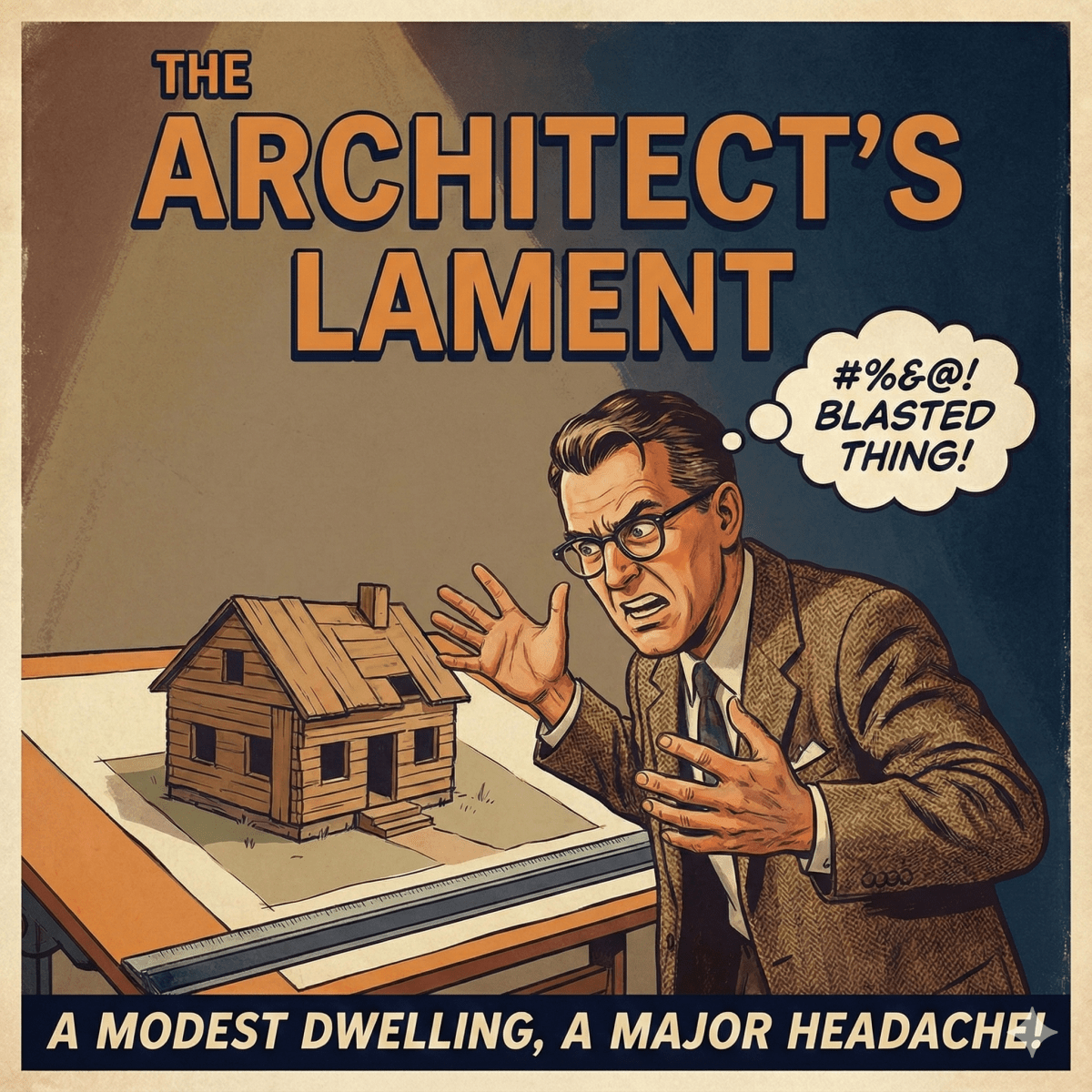
“An architect cursing at a small wooden model of a home, vintage poster”

“A vintage poster of a water bottle mascot walking up a big flight of stairs”


“High quality interior photo of a modern industrial loft overlooking the grand canyon”


“Modern Gable structure with large glass wall facing the sun on a hill in the middle of a forest clearing”


“A coven of witches in the middle of a forest by a fire wearing insane clown posse make up”


“Futuristic neon lit modern ski house on a mountain in the snow”


Case Study 2
As a separate study, here are the results when asking Google Gemini to try and distill the first image from Dall-e, and then improve upon it.
“Take this image which was created by another AI engine. Try to understand what it was attempting to show or the prompt that made it. Take its subject matter and intent of the image, and create a new high quality and improved image. The image should improve in any way it can, including making a whole new image if desired.”
This scratches the surface of asking that if the tool is determining the quality of the result, does that mean that the quality will always go down?


AI This, AI That!
Over the past three years, a proliferation of AI startups, often driven by readily available capital, has emerged, all seeking to capitalize on potential AI applications. The prevailing pitch to venture capitalists appears to be, “Utilize AI to achieve [x] faster.” Investment numbers suggest a period of near-frenzied and perhaps questionable funding activity. This environment pressured almost every company (with the somewhat exception of Apple) to full-steam-ahead enter the AI race, resulting in a somewhat indiscriminate process of experimentation.
Finally, we seem to be in the phase of understanding what is actually sticking.
So… How can we use it?
The emergence of these new AI tools immediately prompted a global conversation: “How can we effectively apply this technology?” Initially, text-based generators like ChatGPT were the primary focus, while image generation models lagged somewhat (as seen in the provided examples).
It’s important to remember that forms of AI similar to what we see today have been utilized in various applications for years. These technologies, which frequently depend on pattern recognition and trained datasets, underpinned features like Google Photos’ image recognition (first introduced in 2017 as Google Lens in a standalone app) and predictive text in email and messaging. The successful real-world applications and validation of these AI approaches were already well established.
When packaged with a specific tool, there are tangible, useful benefits.
AI & Architecture
The design industry found itself grappling with similar questions. At firms across the US, a mere mention of “AI” by developers in one meeting was enough to trigger an office-wide search from misinformed partners: “Jump! OK! We will jump as high as we can! We love jumping!”. This immediately sparked a panic to manufacture an explanation for “how we use AI.”
I’ve personally witnessed this before. It echoes the exact questions developers used to pose: “How do you use BIM?” And the answer, (saying the secret part out loud here)… as in nearly every office, is essentially: “We do use it, but only barely tap into its capabilities. Still, we’ll claim it’s central to everything we do to make you happy and think you are hiring the cutting edge firm we claim we are… even though most of our staff can barely operate within it, relying on a few master users to constantly correct those users’ mistakes.”
The reality is that, ultimately, it won’t matter to the developer either way, they are just all about risk tolerance and a few sound bites. These tools will only be adopted in the design industry if they prove genuinely useful, not because their use is mandated.
Jobs are Leaving!
A major concern arose regarding job security and, perhaps more acutely, the perceived value of work within an industry like Architecture, which already struggles with undervaluation. As other service sectors, such as customer service, accounting, etc, experienced reductions in pay rates and widespread job losses, the question became: was architecture next?
Could AI design a space? Can AI detail a wall?
‘Engineered’ Architecture Tools
Most AI tools claiming to innovate in the architecture space, a sector long overdue and begging for disruption, are fundamentally missing one crucial element: the perspective of practicing professionals.
These tools frequently misunderstand the core difficulties and specific needs of an architect’s job. Take Maket, for instance. Despite being touted as a top AI tool for architects by certain platforms like Architizer, it has 2 reviews and 1 star on Architizer, despite being one of the “top 15 AI tools for Architects” listed by them. This echoes our personal experience as we know zero architects who use it beyond simple experimentation at first. Furthermore, to illustrate our concerns, Maket’s founder and CEO, Patrick Murphy, is not a licensed Architect, and has never worked in an Architecture office.
When examining its features, Maket boasts the ability to “generate hundreds of design options.” This is precisely the opposite of what designers and architects need. It simply creates more work. Hundreds of options to scrutinize, each likely containing minor flaws, adding unnecessary complexity for both the architect and the client are exactly what Architects do not need.
Nuanced Decisions
Nuance is additionally lost in current AI platforms and applications. The inference, understanding, and emotional components crucial to the design process and success of a solution are currently missed. Best attempted to be distilled typically in slider bars or limited parameters that lack even a modicum of ability to capture their intent. While Artificial General Intelligence (AGI) may eventually overcome this, today’s AI tools—even those with limited and focused applications like summarizing meetings or rewriting text—often sacrifice actual substance, fail to prioritize important details, and generally lack sufficient context needed for the design world.
Is Design A Problem To Solve? Or A Creative Expression?
Options Are For When You Don’t Know
Architects often err by preparing too many design options. This habit, which will be the subject of another article— suggests that architects have increasingly lost confidence, transitioning from the role of an ‘expert’ to simply being a ‘catalog.’ This mimics the poor evolution of the architecture profession as a whole, but once again… topic for another day.
There are compelling reasons to present multiple design alternatives. Given the virtually limitless ways a design problem can be solved, the process involves taking these numerous possibilities, refining them through professional expertise, and then offering several thoughtfully curated proposals. Each proposal is, or should be, developed with a specific rationale in mind.
Introducing too many variables at once, similar to a poor scientific methodology, contaminates the results. If the client dislikes the bedroom’s location, how can the architect pinpoint the issue if the bedroom location was changed across all five…or worse… one hundred options?
Providing an excessive number of options yields diminishing returns and can, in fact, harm the final result. The underlying misunderstanding here, which many tools fail to grasp, is that Architecture is not purely science or art, but a constant curated blending of both worlds. It is a continuous process of adjusting values, inputs, desires, context, and a multitude of other factors that ultimately converge into a functional, physical space.
Parameters Are Impossible to Quantify
This process of architectural design, especially for those who have spent time in the industry, is notoriously complex. It involves an overwhelming mix of legislative demands, such as code and zoning requirements, coupled with client specifications, the constraints of physics (MEP and structural), and simple things like client desires or market trends regarding sellable aesthetics. This combination makes the entire endeavor chaotic, non-linear, and often described by the phrase, “design never ends.”
This complexity is fundamentally resistant to being distilled into a singular algorithm. The challenge isn’t just the sheer volume of data; it’s the inherent incompatibility, exemplified by conflicting code requirements between different legislative bodies in certain cities, or the simple dilemma of a client duo where one partner wants black, while the other partner demands white. How do you create an algorithm to reconcile conflicting inputs?
Consequently, in Architecture—particularly in the urban environments where the firms that could afford advanced tools operate—buildings are shaped as much by these unique, often contradictory “edge cases” as they are by functional needs or aesthetic preferences.
Most of these tools try to imitate results, rather than focus on a process.
“Let Me Automate… What You Like To Do”
Artists generally cherish the act of creation… the painting, the ideation, and the overall process. The parts they dislike would perhaps be selling their work, year-end reporting, and the other necessary business functions— which are the least “artistic” aspects of their profession. These tasks, like marketing and bookkeeping, are often distinct professions themselves, and most artists would gladly hire someone to manage them professionally if they could afford it.
While the architecture and art businesses differ, their operational processes share common ground. Architects and designers, similar to artists, find joy in the act of designing. Therefore, why would we seek to automate the very creative acts that provide the profession’s saving grace?
It would be like telling a Michelin-star chef, “I will choose what you cook and cook it myself, but don’t worry, I’ll still let you be in the kitchen.” This would strip away the magic of their personal touch and the uniqueness of the creative process which inherently provides the value desired by clientele.
The Projects Change, The Tools Cant
A critical, yet often ignored, issue in design is data interoperability. Professionals dedicate a lot of time to making data modeled in one program somewhat usable in another— sometimes requiring full time people for this very task. A significant and ongoing industry problem. Consider Speckle, which recently raised $12.5 million to create, “an open-source data hub for the AEC industry, aiming for better collaboration and data flow.” Even translating between two Autodesk products, like CAD and Revit, can be a full-time job and they are owned by the same company! Furthermore, Autodesk acquired Revit in 2002, yet native PDF linking—a format invented in 1993—only became possible in 2021.
The expectation that architects or designers can successfully leverage one tool for schematic design, transfer it to a second for design development, and finally document it in a third, wrongly assumes that the tool’s innovation will outweigh the hurdle of platform incompatibility.
Some argue this situation highlights the industry’s lack of technological progress and justifies the need for new tools. However, a different perspective suggests that if tools aren’t strategically focused on managing the entire workflow (A to Z), they cannot achieve proper, widespread adoption.
Specific Use Tools
The core challenge for AI in architecture, and why the industry is still decades away from true disruption by these tools, lies in their inability to grasp the process’s complex nuances. Today’s most effective AI tools are utilities for automating tedious, non-architectural tasks, such as generating meeting minutes or itemizing receipts for reporting.
Applying these generalized tools to design applications overlooks the specific challenges of professional practice and fails to grasp the profound, focused complexity of the problems they aim to solve. For instance, while an algorithm might view planning a bedroom as similar to rephrasing a paragraph of text, the two are fundamentally different for a host of reasons.
Even when used for seemingly useful tasks, like rewriting sentences or capturing meeting notes, architects must be aware of the tools’ limitations. As previously discussed, the lack of nuance can lead to errors and crucial omissions.
Concluding Thoughts
Current architecture and design-specific AI tools are largely ineffective for professional practitioners. While we must acknowledge the undeniable pace of innovation and remain open to future possibilities, significant, tangible improvements in Architecture and AI are still distant, outside of highly specific, narrow applications. Designing a space is not merely a problem to be solved; it’s a complex process, no easier to codify than crafting a successful legal defense or a Michelin-star menu.
A more significant long-term concern is the eventual outcome of relying on an ever-decreasing library of solutions derived repeatedly from existing patterns.
The available tools often fundamentally misunderstand the profession. They typically focus on generating an overwhelming number of design options, failing to manage the unquantifiable and often contradictory parameters that include building codes, client needs, and the subjective opinions of architects and designers. By attempting to automate the very creative core of the architect’s job, these tools miss what actual professionals would ideally like to automate.
These current tools will likely gain some traction among entities like home builders, developers, and owners, primarily as a means to reduce professional industry compensation. Some architecture firms might also adopt them. However, in our view, no dramatic shifts are imminent, and the necessity of Architects and Designers will continue for the foreseeable future.

