
Back in beta! Stay tuned.

climate

Weather & Site Design
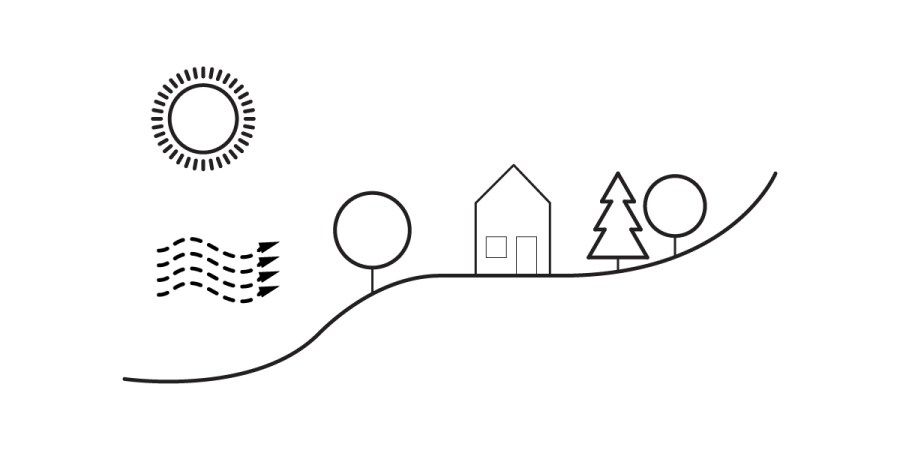
A simple line drawing illustrating thoughtful site design—a sun, wavy lines for weather elements like water or wind, two round trees, a house, a pine tree, and a curved hill.

Effective site design begins with allowing the local climate and context to fundamentally influence a building's form, transcending the reliance on active mechanical systems. Best practices necessitate heeding cardinal directions, solar exposure, and wind dynamics. Furthermore, thoughtful site plantings function beyond aesthetics, offering significant energy conservation and microclimate moderation. Mastering the interplay of topography, material albedo, and wind patterns is crucial for creating sustainable and site-responsive architecture.

Climate Regions

A simple black outline icon featuring a sun, a thermometer, and two curved lines for wind on a white background. The elements suggest a weather or Climate Regions theme.

Understanding climate regions is crucial for effective building design and construction, especially in the US. The International Energy Conservation Code (IECC) and Pacific Northwest National Laboratory (PNNL) categorize the country into 8 temperature-oriented climate zones and 3 climate regimes (A, B, C). This framework guides building science, energy code compliance, and proper material selection, ensuring efficient and high-performing structures tailored to specific environmental conditions.