Back in beta! Stay tuned.
admin

admin

Historic Preservation & Misc Information

A simple black and white line drawing of two classical columns, ideal for historic preservation references. The column on the left has a plain capital, while the one on the right features a capital with spiral volutes.

Historic preservation offers diverse approaches, from restoring a structure to its most significant era to preserving its evolving character over time. Whether rehabilitating a space for new uses or reconstructing a lost building, the goal is to maintain historical accuracy while addressing modern needs. These strategies balance scope, cost, and societal value, ensuring that buildings of cultural importance continue to enrich our communities.

Open to Below; Open to Above

A large solid-lined square and a smaller solid-lined square appear on a white background. Both squares, marked “Open to Below,” have diagonal lines inside. Dashed lines connect their corners, outlining a larger rectangle.

Deciphering "open to below" and "open to above" in architectural plans is crucial for clarity. "Open to below" areas, visible within the view range like floor openings or shafts, are delineated with solid lines and an "X" mark. Conversely, "open to above" spaces, such as multi-story atriums or soffits, are represented by dashed lines, indicating elements not directly seen in the current plan view. Understanding these graphic standards ensures precise communication in architectural documentation.

Industry Graphic Standards

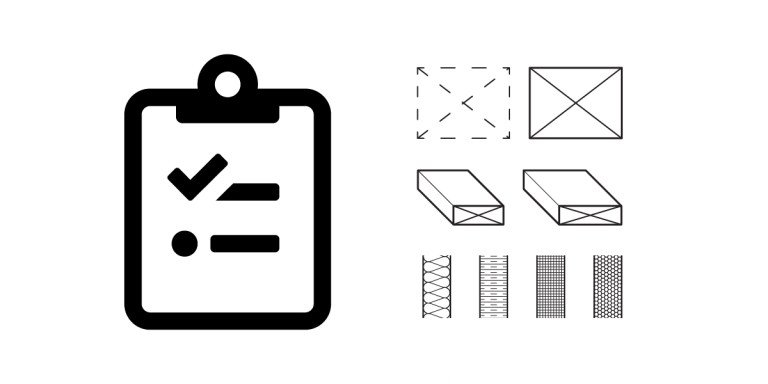
A large clipboard icon with checkmarks is on the left. On the right are six diagrams showing boxes in various orientations and three grid patterns, reflecting Industry Graphic Standards. The background is white.

Graphic standards in architectural documentation are dynamic, constantly evolving with project needs and office conventions. While internal guides are essential, a commitment to industry consistency enhances legibility and streamlines collaboration. These standards, developed through diverse project experiences, aim to provide a flexible framework, encouraging adaptation and refinement to best serve the unique communication goals of each drawing type.

Plaster & Wallboard

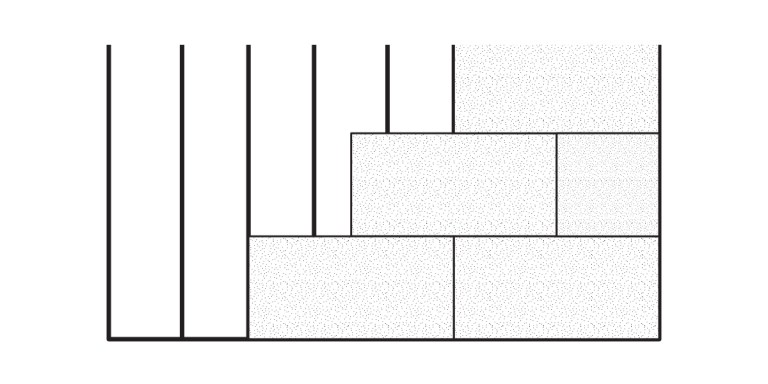
A diagram shows four vertical lines on the left and a staircase pattern of five shaded rectangles, resembling stacked wallboard, on the right. This creates two distinct sections in the image with the rectangles aligned to form steps.

Plaster, drywall, backerboard, and cement board are distinct products often confused due to their similar appearances and interior finishing applications. While many terms are interchangeable, each material offers specialized performance results and utilizes different technologies. Understanding these differences is crucial for architects and builders to select the appropriate solution for specific project requirements, from fire resistance and sound control to moisture protection in wet areas.

Metals, Steel, Alloys

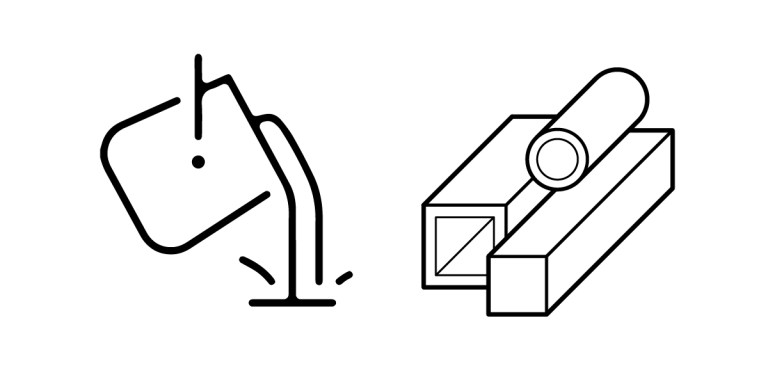
A line drawing shows liquid metal, possibly steel or alloys, being poured from a container on the left and three solid metal bars, including one cylindrical piece, on the right.

Metals are incredibly versatile construction materials, rarely used in their purest form. Alloying metals, like adding chromium and nickel to steel to make it stainless, enhances desirable properties such as strength, hardness, and corrosion resistance. From refining through smelting to various fabrication methods like casting, rolling, and extrusion, metals are shaped and treated to achieve optimal characteristics for architectural applications.

Water Treatment

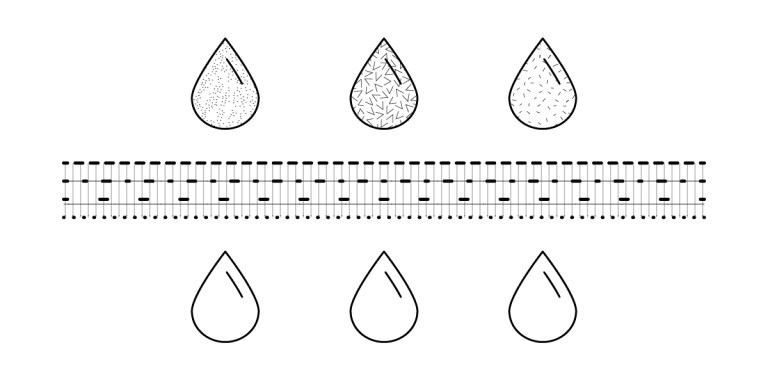
Three patterned water droplets above a horizontal barrier representing a membrane, and three plain water droplets below—illustrating solar heating in water treatment—are all evenly spaced on a white background.

Water is essential for life, and ensuring its health and safety is paramount, especially in developed nations where it's often taken for granted. Beyond basic health, optimizing water quality involves considering factors like pH, chemistry, and mineral content. This exploration delves into various water factors and issues, from acidity and hardness to biological contaminants, and outlines the critical treatment methods—pre-treatment, filtration, demineralization, and disinfection—necessary for elevating water from merely healthy to truly optimal.

Controlling Sound; NRC and Absorption

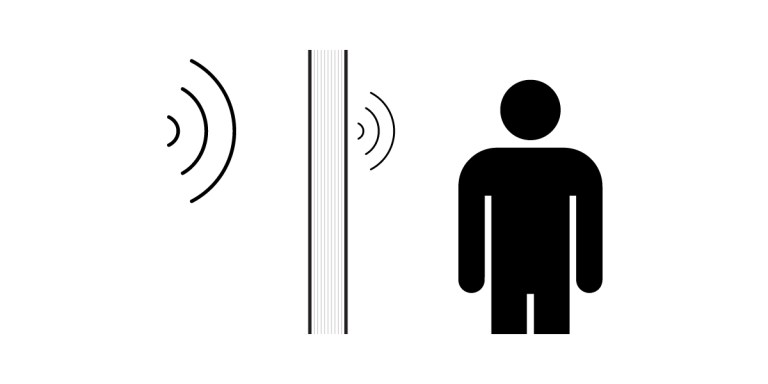
A simple illustration shows sound waves of varying frequency on one side of a vertical barrier and a person icon on the other, indicating how sound passes through or around the barrier to reach the person.

Controlling sound is crucial in architectural design, addressing external noise and internal room-to-room transmission to enhance user comfort. This guide explores three key strategies: reducing sound at the source, modifying space absorption, and introducing non-intrusive background noise. Understanding frequency-specific mitigation, exterior material considerations, and effective room planning criteria are essential for achieving optimal acoustic performance in any structure.

Construction Overhead and Profit

A simple line graph with an upward trend is shown next to an outline of a generic person icon, indicating progress or growth related to Construction Management for an individual.

Understanding construction overhead and profit is crucial for any successful project. General contractors operate as businesses, with primary goals of profitability. This includes covering general operating costs (General Overhead) and project-specific expenses (Project Overhead), distinct from labor, materials, and equipment. Profit percentages vary widely based on project size, type, economic conditions, and associated risks, highlighting the dynamic nature of construction finance.

Climate Regions

A simple black outline icon featuring a sun, a thermometer, and two curved lines for wind on a white background. The elements suggest a weather or Climate Regions theme.

Understanding climate regions is crucial for effective building design and construction, especially in the US. The International Energy Conservation Code (IECC) and Pacific Northwest National Laboratory (PNNL) categorize the country into 8 temperature-oriented climate zones and 3 climate regimes (A, B, C). This framework guides building science, energy code compliance, and proper material selection, ensuring efficient and high-performing structures tailored to specific environmental conditions.

The Bidding Process

Three cards, each with a hand pointing at them, illustrate different bid amounts—two dollar signs, three dollar signs, and one dollar sign—representing stages of the bidding process.

Navigating the construction bidding process is crucial for successful project delivery. While the lowest acceptable bona fide bid is often the theoretical winner, real-world factors like relationships, scheduling, and company history heavily influence the final decision. Understanding key definitions, bid timeliness, and the impact of construction time and materials is essential for architects and owners to secure quality bids and ensure project success.