Back in beta! Stay tuned.

energy

Weather & Site Design
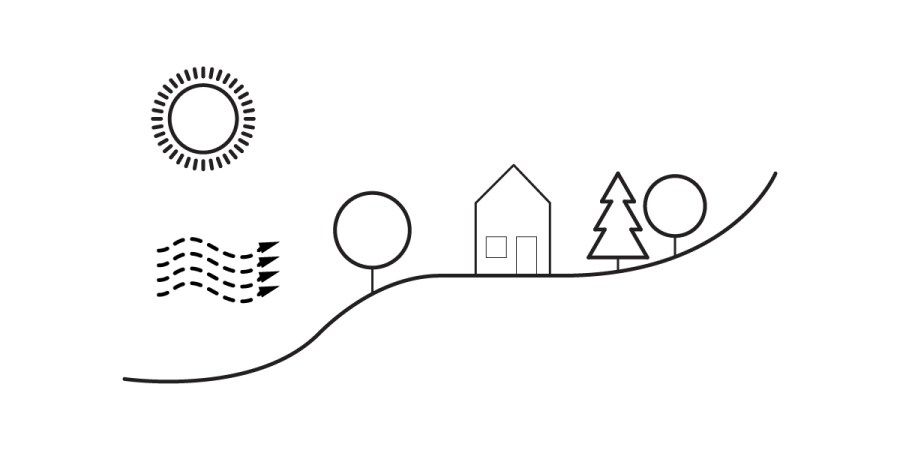
A simple line drawing illustrating thoughtful site design—a sun, wavy lines for weather elements like water or wind, two round trees, a house, a pine tree, and a curved hill.

Effective site design begins with allowing the local climate and context to fundamentally influence a building's form, transcending the reliance on active mechanical systems. Best practices necessitate heeding cardinal directions, solar exposure, and wind dynamics. Furthermore, thoughtful site plantings function beyond aesthetics, offering significant energy conservation and microclimate moderation. Mastering the interplay of topography, material albedo, and wind patterns is crucial for creating sustainable and site-responsive architecture.

Solar Water Heating

A simple illustration showing solar water heating: the sun shining, wavy lines representing heat moving down to water, and icons of a rising arrow and thermometer indicating increasing temperature.

Solar water heating offers a sustainable approach to energy, harnessing the sun's power to reduce reliance on mechanical systems. Various types exist, including batch, thermosiphon, closed-loop active, drain-down, drain-back, and phase change systems, each with unique operational characteristics and considerations for efficiency, freezing protection, and installation. Understanding these diverse system connections, from direct to indirect and passive to active circulation, is crucial for integrating solar water heating effectively into building designs, optimizing for both performance and cost.

Photovoltaics (Solar Panels)

A simple line drawing showing a sun—representing solar panels—on the left and three battery icons on the right, each with charging bars displayed inside.

Photovoltaic systems (PVs) convert sunlight into electricity, utilizing semiconductor materials that generate DC electricity, which is then transformed into AC. PVs can be arrayed or integrated into structures and must comply with safety codes. They offer renewable energy benefits, but have high initial costs and require favorable locations for efficiency.

Materials Sustainability Overview

A black line drawing of a circular arrow on the left and a hand holding a sprouting plant on the right symbolizes materials sustainability, all set against a white background.

As architects increasingly balance cost, function, time, and aesthetics, sustainability has become a critical design aspect. Beyond mere marketing, a true understanding of sustainability must permeate all project decisions. Evaluating building materials involves quantifying embodied energy, prioritizing renewable and recycled content, considering local sourcing, assessing material toxicity, and ensuring durability, maintainability, and recyclability. These criteria guide the selection of materials like concrete, masonry, steel, wood, and plastics, each with unique advantages and disadvantages for sustainable construction.

Climate Regions

A simple black outline icon featuring a sun, a thermometer, and two curved lines for wind on a white background. The elements suggest a weather or Climate Regions theme.

Understanding climate regions is crucial for effective building design and construction, especially in the US. The International Energy Conservation Code (IECC) and Pacific Northwest National Laboratory (PNNL) categorize the country into 8 temperature-oriented climate zones and 3 climate regimes (A, B, C). This framework guides building science, energy code compliance, and proper material selection, ensuring efficient and high-performing structures tailored to specific environmental conditions.

Dear Walmart; Don’t Forget to Turn Off the Lights (Case Study)

Two abstract flower-like shapes are shown side by side on a white background, reminiscent of lights. The left shape is filled in black, while the right has a black circular center and outlined petals. Both have six petals.

This theoretical exercise evaluates the significant value of building commissioning by examining energy and monetary savings at a local Walmart. Despite being a multi-billion dollar company, the persistent issue of parking lot lights remaining on during daylight hours highlights overlooked inefficiencies. While the direct financial cost is a mere "rounding error" for Walmart, the substantial energy waste—equivalent to the annual electricity use of over 4,200 homes—underscores a critical environmental concern for companies committed to sustainability.

Energy Recovery & Conservation Strategies

A simple black outline of a light bulb inside a circular arrow loop, symbolizing ideas, innovation, energy recovery, or continuous improvement. The background is white.

Optimizing HVAC system efficiency is crucial for reducing building energy consumption, which typically accounts for 40-60% of a building's overall energy use. This comprehensive guide explores various energy recovery and conservation strategies, including advanced mechanical systems, heat transfer methods, and building automation systems. Discover how innovative approaches like dual-condenser cooling, absorptive cooling, and variable refrigerant flow systems can significantly enhance sustainability and cost-effectiveness in building design and operation.

Fuel & Energy Sources

A simple black and white line drawing of a fuel pump with a hose, next to a gauge with a needle pointing to the right, symbolizing fuel as one of the key energy sources.

Achieving Net Zero buildings remains a challenge, necessitating supplemental energy. Fuel source selection hinges on availability, efficiency, and cost, with options like natural gas, propane, oil, electricity, and steam each presenting distinct advantages and considerations. Understanding how these fuels convert to useful energy, and the equipment like furnaces, boilers, and heat pumps that facilitate this, is crucial for optimizing building performance and sustainability.

Glass Energy And Performance

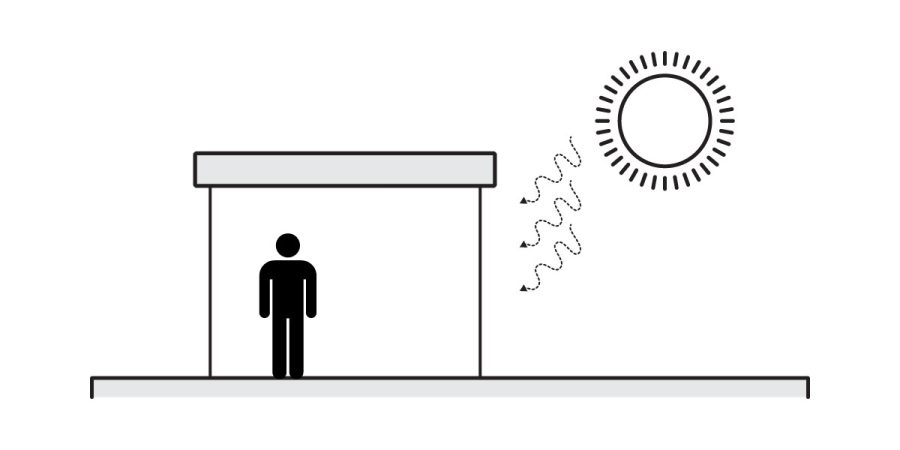
Diagram showing sunlight shining on a vertical tube, with wavy arrows indicating light and Glass Energy entering through the sides of the tube. The sun is depicted in the upper right corner.

Glass is a critical element in building design, offering benefits like natural light and views that positively impact well-being. However, it also presents challenges regarding heat loss and gain. Understanding energy measurements such as U-Value and Solar Heat Gain Coefficient (SHGC) is crucial for balancing efficiency with aesthetic considerations, ensuring optimal performance in different climates and reducing energy consumption.